Choosing the Right Energy Affordability Policies for Your State

Energy affordability is a crisis across the country, but the reasons bills are high vary from state to state.

In some places, climate impacts and wildfire costs are driving rate hikes; in others, it’s new infrastructure, data centers, or aging, inefficient housing.

The Just Solutions Energy Affordability Policy Library is designed to help climate justice advocates, organizers, and policy staff sort through these complexities and identify concrete policy options that can move the needle in their state. It offers a deep dive into dozens of policies that can be enacted at the state or local level to ensure households have access to clean, reliable, and affordable energy.

1. Understanding what’s driving unaffordable energy in your state

To answer this question, you don’t need precise data to get started, but you do need ideas and hypotheses to get going. Try answering these questions as concretely as possible:

What’s been happening to energy bills over the past 3–5 years?

Who is being hit hardest (by income, race, geography, housing type, or utility territory)?

What do you think is driving high bills or bill increases?

Common contributing factors might include climate-related natural disaster impacts, new infrastructure and projects, fossil fuel price volatility, new large loads on the grid, poor building quality, and utility profit structures.

If you don’t have data on causes and impacts, consider policies that focus on bill and data reporting and transparency as early priorities. For example, some states require utilities to break out cost drivers on bills or to report fuel cost impacts separately.

How to use the library here:

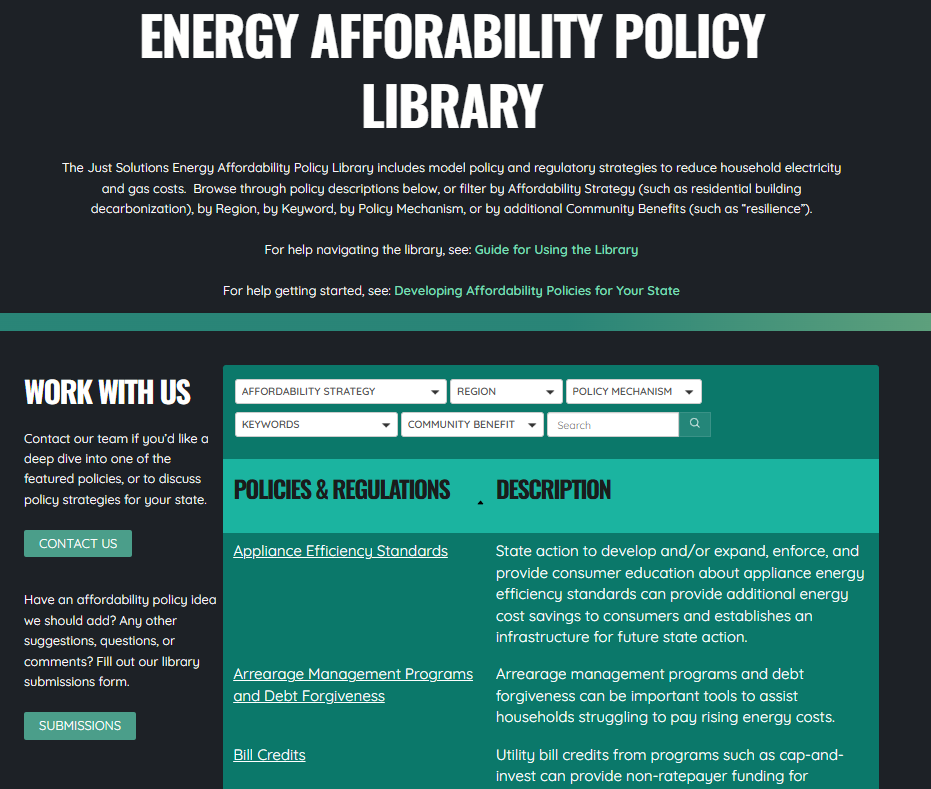
Use the Keyword search to look up the issues you’re seeing (e.g., “data centers,” “grid infrastructure,” “housing” “efficiency”).

Scan the “Why This Matters” section of entries to see whether they match the problems you’re observing.

This step helps you narrow an overwhelming list of policies into a shorter set that actually speaks to your state’s reality.

2. Protecting households now: near-term relief and safeguards

Again, you don’t have to wait for perfect analysis to move policies that keep people connected to an energy source and reduce immediate harm. Early, near-term priorities often include:

Bill assistance

Shutoff protections

Arrearage management

For example, some states have implemented seasonal disconnection moratoria to ensure no household loses service during extreme heat or cold. These policies may not fix the root causes of unaffordability, but they can buy time, reduce harm, and build power by demonstrating that better protections are possible.

How to use the library here:

Filter by Affordability Strategy to find policies that focus on direct relief, customer protections, or arrearages (“Household Protections”).

Review the Model Policy Features to understand what’s needed to make these protections effective and equitable.

Pay attention to Potential Policy Limitations and Pitfalls—including in the Examples section—such as temporary programs that end abruptly, or protections that don’t reach people with the highest need.

If your work needs a “first win,” these policies can often be framed as basic safeguards and may be more politically feasible in the near term.

3. Addressing root causes and structural drivers

Once you have some protections in place, you can look at policies that address underlying causes. These often involve bigger ideas and solutions that create much bigger long-term impact. Some examples include:

Utility reform and oversight:

Requiring stronger accountability and cost allocation; aligning utility incentives with affordability and equity agendas; and accelerating clean energy in ways that actually reduce customer costs over time. For example, some commissions require utilities to demonstrate cost-saving alternatives before pursuing expensive infrastructure projects.

Household-level solutions:

Equitable building decarbonization and weatherization; enabling on-site generation options (rooftop or balcony solar); implementing efficiency upgrades. For example, some cities have adopted low-income weatherization programs that cut bills immediately and permanently.

How to use the library here:

Use Affordability Strategy plus Community Impact filters to find policies that both reduce bills and deliver broader benefits like resilience and climate mitigation.

Read Complementary Policies to see how near-term protections can pair with structural reforms (for example, pairing arrearage management with long-term efficiency or rate design changes).

Use Examples to understand how similar policies have played out in other states, including limitations or challenges.

This step is where you can build a portfolio of policies that help now (near-term), and some that will ultimately change the underlying system (long-term).

4. Matching policies to the right-decision making venue

Once you have some protections in place, you can look at policies that address underlying causes. These often involve bigger ideas and solutions that create much bigger long-term impact. Some examples include:

Governor’s Offices

Authority: Executive orders, agency directives, budget priorities

Pros: Can be relatively fast; can elevate an issue statewide

Limitations: Vulnerable to changes in administration; may be limited in scope

State Legislature

Authority: Statutes creating new programs, mandates, funding streams, or protections

Pros: More durable changes, can embed equity and affordability in law

Limitations: Gridlock, long timelines, possible dilution through amendments

Regulators/Public Utility Commissions

Authority: Rate cases, rulemakings, resource planning, consumer protections

Pros: High impact on rates, program design, and utility behavior

Limitations: Technical, often inaccessible; some commissions are captured or hostile; cannot access non-ratepayer funding

Local Governments

Authority: Building codes, local programs, resilience hubs, zoning, municipal utilities

Pros: Potentially more responsive; can pilot innovative approaches

Limitations: Uneven authority; limited staffing; may not reach entire utility service

Federal Government

Authority: Funding programs, standards, and regulations that shape state options

Pros: Resources and alignment for big investments

Limitations: Limited direct control at state level; subject to federal political shifts

How to use the library here:

Use the Policy Mechanism filter to identify whether a policy typically moves through legislative, regulatory, executive or other spaces.

Use the Region filter to see if policies are more often local, state, regional, or federal.

It’s important to be honest about pitfalls: some venues may be blocked or “captured” right now, which requires a longer effort. In that case, identify alternative venues that can move pieces of the solution forward, or lay the groundwork for future fights.

5. Addressing narrative, coalition support, and funding

Even the best-designed policy won’t move without a grounding in real lives coupled with a compelling story, trusted messengers, and a coalition that can withstand opposition. Consider these questions:

Narrative & Public Support:

How does energy affordability connect to people’s daily lives, health, housing, and dignity? What stories or data points will resonate across communities? How do you talk about affordability and clean energy together without treating one as a trade-off for the other?

Building Coalitions:

Are there allies outside the usual climate space? Is there a bipartisan path that could support at least part of your campaign?

Funding & Cost:

Where would the funding realistically come from (state budgeted, federal funds, utility programs, rate design changes)? Are there ways to design policies that protect low-income customers while spreading costs differently?

How to use the library here:

Look at the Potential Drawbacks and Pitfalls and Resources sections to anticipate opposition arguments and find tools (like model language or research) that support your narrative.

Use Community Impact to identify policies that offer co-benefits (health, resilience, climate) you can lift up publicly.

Filter by Affordability Strategy to find policies that focus on funding and financing.

6. Putting it all together

Wherever your state’s affordability work currently stands, this Guide and the Energy Affordability Policy Library can help clarify your pathway forward. Use this Guide to diagnose your state’s challenges, identify promising policies, choose the right venue, and strengthen your narrative and coalition. Use the Library to deepen that understanding, compare options, and understand the tradeoffs of each policy tool.
If you’re unsure what’s driving bills up, start at Section 1.

If your coalition is in emergency mode, start at Section 2 with disconnection protections, bill assistance, etc., and then use Section 3 to identify reforms.

If your policy idea is clear but you’re stuck on where to move it, go straight to Section 4 and use the Policy Mechanism and Region filters to identify venues and options.